

Scented Candles That Don't Cause Headaches: The Science of a Clean Burn
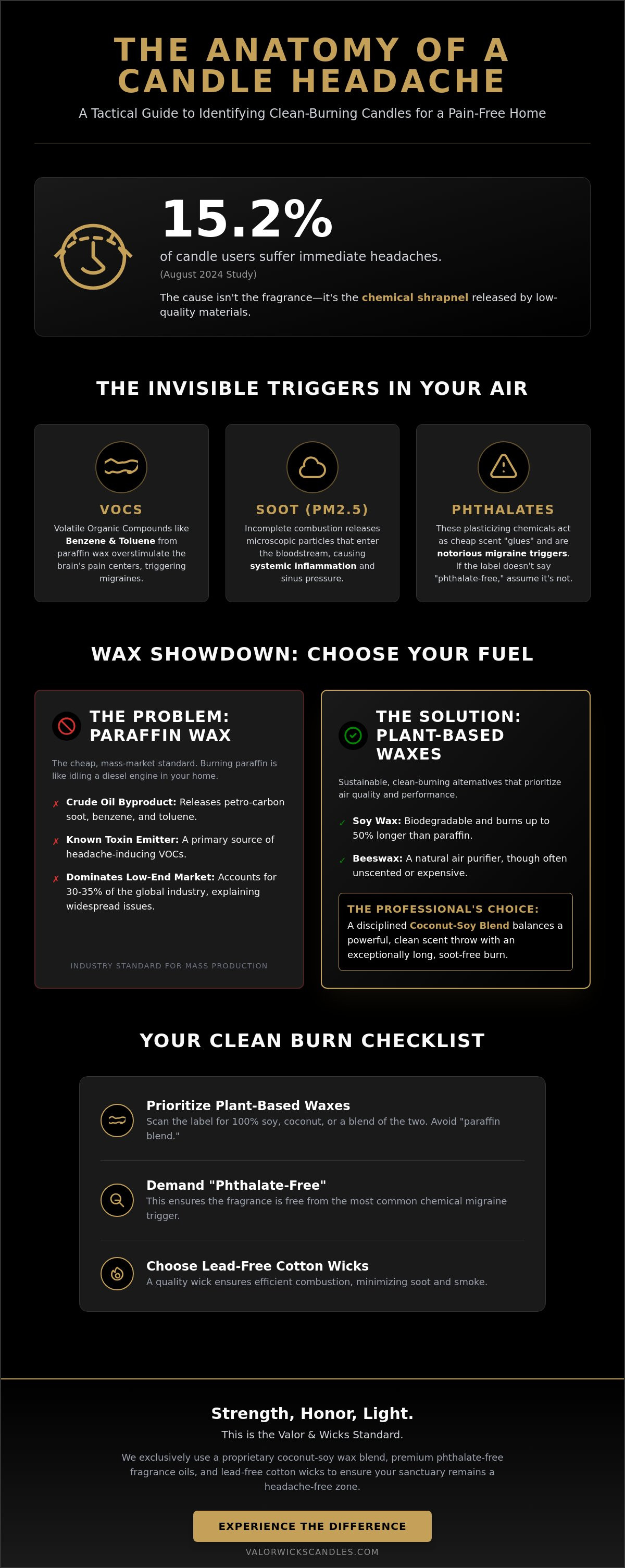
In August 2024, a study revealed that 15.2% of candle users suffer from immediate headaches after lighting their favorite scents. It's not the fragrance itself. It's the chemical shrapnel. You want a home that smells like a retreat, not a pharmacy. We understand the physical toll of sinus pressure and lingering soot. Finding scented candles that don't cause headaches shouldn't feel like a gamble with your health. It requires a disciplined look at what's actually burning in that jar.
You deserve a home that smells like a sanctuary, not a chemical plant. We'll show you exactly which ingredients to avoid so you can enjoy premium fragrance without the physical toll. This guide breaks down the science of clean-burning waxes and identifies the specific label markers used by high-tier artisans. We'll even look at how March 2026 paraffin price spikes affect the quality of what you buy. Strength, Honor, Light. Let's clear the air.
Key Takeaways
- Identify the link between Volatile Organic Compounds (VOCs) and the overstimulation of your brain's pain centers.
- Learn to source scented candles that don't cause headaches by prioritizing sustainable plant waxes instead of paraffin-based crude oil byproducts.
- Decode candle labels to ensure your home remains a phthalate-free zone. This eliminates the most common trigger for instant sinus pressure.
- Execute a perfect first burn with lead-free cotton wicks to ensure efficient combustion and a soot-free sanctuary.
- Discover the specific coconut-soy ratio that balances a powerful scent throw with a disciplined, clean burn.
Why Most Candles Hurt: The Science of the 'Candle Headache'
You light a candle to relax after a long day of adulting. Ten minutes later, your temples are throbbing and your sinuses feel like they're in a vice. This isn't just a "strong smell" problem. It's a chemical ambush. The common candle headache is a physiological reaction to Volatile Organic Compounds (VOCs) and microscopic soot particles. When you burn low-quality materials, you're essentially staging a small-scale industrial event in your living room. Finding scented candles that don't cause headaches starts with understanding that your body is reacting to "shrapnel" in the air, not the fragrance itself.
Your olfactory nerve is a direct highway to the brain's pain centers. It's the only sensory nerve with an immediate path to the central nervous system. When harsh synthetics hit this nerve, they can overstimulate the trigeminal system, which is the primary pathway for migraines. It's not about how loud the scent is, it's about the integrity of the molecules. A massive scent throw from a clean botanical source is often safer for your head than a faint, "whispering" scent packed with petroleum fixatives. Understanding the science of candle wax and fragrance quality is the first step toward a pain-free home.
The Olfactory Trigger: Scents vs. Chemicals
There's a massive difference between a fragrance allergy and a chemical sensitivity. Many "luxury" brands use phthalates, which are plasticizing chemicals that make a scent linger for hours. These fixatives are notorious migraine triggers. While synthetic fragrances aren't inherently evil, poorly formulated ones rely on these cheap "glues" to stay potent. High-quality botanical oils and safe synthetics interact with your olfactory system with precision, whereas petroleum-based perfumes act like a blunt instrument against your senses. If your candle label doesn't explicitly scream "phthalate-free," your brain might be the one screaming instead.
Soot: The Invisible Migraine Trigger
Black soot is the hallmark of a dirty burn. It occurs when the flame can't fully consume the fuel, leading to incomplete combustion. This process releases fine particulate matter, specifically PM2.5. Studies from May 2026 show that burning certain materials can increase indoor PM2.5 concentrations to levels 10 to 20 times higher than the EPA's outdoor air quality standards. These particles are small enough to enter your bloodstream through your lungs, triggering systemic inflammation and instant sinus pressure. Scented candles that don't cause headaches prioritize a clean, efficient burn to keep these microscopic invaders out of your system. Strength, Honor, Light. We don't do dirty burns.
Wax Comparison: Finding Scented Candles That Don't Cause Headaches
Choosing the right fuel is a matter of discipline and integrity. If you're hunting for scented candles that don't cause headaches, the wax is your primary target. Most mass-market candles rely on paraffin because it's cheap and easy to mass-produce. As of March 2026, paraffin prices in North America reached approximately $1.30/KG. While this keeps profit margins high for big-box retailers, it compromises your air quality. Paraffin is a crude oil byproduct. When you burn it, you're essentially idling a diesel engine in your living room. Paraffin wax consumption accounts for 30-35% of the global industry as of April 2026, which explains why so many people struggle with candle-induced migraines.
Alternative waxes exist, but they aren't all created equal. Beeswax is a natural air purifier, yet it's notoriously difficult to scent effectively and often carries a high price point. Soy wax is a popular choice because it's biodegradable and burns 30-50% longer than paraffin. However, soy alone often lacks "scent throw," the ability to fill a room with fragrance. The professional solution is a precise blend that prioritizes both performance and health. By combining the stability of soy with the clean-burning properties of coconut wax, you create a sanctuary that smells incredible without the chemical fallout.
The Problem with Paraffin
Big-box brands choose paraffin for its low cost, but the trade-off is petro-carbon soot. This isn't just a cleaning nuisance; it's a direct threat to your neurological comfort. Paraffin releases benzene and toluene, two chemicals famously linked to the health risks of scented candles. These toxins are known VOCs that can trigger immediate sinus pressure and throbbing temples. If you've ever felt a "hangover" after burning a cheap candle, you've likely been huffing petroleum exhaust. High-tier craftsmanship demands a better standard for your home.
The Coconut-Soy Blend: The Professional's Choice
Coconut wax is the secret weapon for anyone seeking a headache-free experience. It burns cooler and cleaner than almost any other medium. When you blend coconut with soy, you get a wax that carries fragrance beautifully without needing synthetic "boosters." This blend has a significantly lower melting point, which means fewer toxins are released during combustion. It's a sustainable, disciplined approach to home fragrance. You get the atmosphere you want without the physical toll. If you're ready to stop gambling with your health, our Signature Collection uses this high-tier blend to ensure every burn is as clean as it is bold. Strength, Honor, Light.
Fragrance Integrity: Phthalates, Synthetics, and Natural Oils
Scent should soothe, not sabotage. If you’ve been burned by expensive "luxury" brands that leave you reaching for ibuprofen, the culprit isn't the aroma. It's the chemical glue. Achieving a room-filling "hot throw" without the chemical punch requires discipline. It requires botanical integrity. Most mass-produced fragrances rely on cheap fixatives to stay potent, but those shortcuts come at a physical cost to the consumer. Finding scented candles that don't cause headaches means looking past the pretty label and demanding better ingredients.
The Phthalate Factor
Phthalates are plasticizers. In the candle industry, they act as fixatives to make a scent linger in the air for hours. They are also known endocrine disruptors. When these molecules are heated and inhaled, they can trigger immediate neurological stress and sinus inflammation. By April 2026, "phthalate-free" became the global procurement standard for B2B buyers and health-conscious artisans alike. This shift isn't just a trend; it's a necessity for indoor air quality. Truly scented candles that don't cause headaches must be verified phthalate-free to ensure they don't overstimulate the brain's pain centers. Stop huffing chemical glues. Your sanctuary deserves better.
Essential Oils: The Pros and Cons
Don't fall for the "100% essential oil" marketing trap. While natural sounds superior, raw essential oils often have very low flash points. When they are subjected to the high heat of a candle flame, they can lose their therapeutic properties or even become toxic irritants. Artisanal fragrance oils are often the superior choice for a clean burn. These are specifically engineered for high-heat combustion, providing a consistent scent without the risk of degradation. Consistency is key to a headache-free experience.
A pulmonologist recently detailed how scented candles can impact your health, highlighting that Volatile Organic Compounds (VOCs) are the primary triggers for respiratory and neurological distress. To keep your home safe, avoid heavy synthetic musks and "mystery" perfumes. Stick to light citruses, clean botanicals, or our Signature Collection, which uses high-tier, safe synthetics designed for stability. As of January 2026, new EU regulations have already begun removing high-risk substances from fragrance formulations to protect consumers. We've been ahead of that curve from day one. Strength, Honor, Light. We use science to protect your peace.
- Avoid: Phthalates, heavy synthetic musks, and "parfum" with no listed source.
- Seek: Botanical blends, phthalate-free synthetics, and high-flash-point oils.
- The Result: A bold scent throw that doesn't end in a migraine.
The Clean Burn Ritual: How to Prevent Candle Headaches at Home
Finding scented candles that don't cause headaches is a tactical victory, but how you maintain that candle determines the final outcome. Even a premium coconut-soy blend can turn into a soot factory if you ignore the basics. It requires discipline. It requires precision. A clean burn is a science, and your ritual at home is the final step in protecting your sanctuary. If you’re burning a candle while adulting through a mountain of laundry, don't let a poorly trimmed wick add a migraine to your to-do list.
Mastering the Wick
The wick is the engine of your candle. If the engine is dirty, the exhaust is toxic. While the CPSC has strictly regulated lead in wicks since 2003, mandating that metal cores contain no more than 0.06% lead by weight, many mass-market brands still use zinc or other metal cores to keep wicks upright in cheap paraffin. These burn excessively hot. You want 100% cotton or paper-core wicks. When a wick "mushrooms"—that carbon buildup at the tip—it’s a sign of incomplete combustion. Trim it to 1/4 inch before every single light. This simple act can reduce particulate matter emissions by up to 50%, keeping your air clear and your head light.
Environmental Factors
Your environment dictates the burn quality. Never place your candle in a drafty hallway or near an open window. Air currents make the flame flicker, which destabilizes the combustion process and pumps soot into your room. Follow the "two-hour rule" for your first burn: let the wax pool reach the edges of the jar. This prevents tunneling and ensures the fragrance oils are released at the intended temperature rather than burning off too quickly. When you're finished, don't just blow it out. That "smoke cloud" is a concentrated burst of everything you just tried to avoid. Use a lid or a snuffer to kill the oxygen without the soot.
For those days when even a clean flame feels like too much, consider a flame-free approach. Our Wax Melts offer the same high-tier botanical scents without any combustion, making them a perfect alternative for the most sensitive users. Whether you're burning or melting, keep your standards high. Strength, Honor, Light.
- Trim wicks to 1/4 inch before every use.
- Allow a full melt pool to prevent tunneling.
- Avoid drafts to maintain a stable, clean flame.
- Use a snuffer to extinguish without the smoke.
Strength, Honor, Light: The Valor & Wicks Standard
At Valor & Wicks, we don't just pour wax into jars. We execute a mission. Our veteran-led discipline ensures that every product leaving our facility meets a standard of excellence that mass-market brands simply cannot match. If you are searching for scented candles that don't cause headaches, you need a product built with integrity. We understand that your home is your sanctuary. It shouldn't be a place where you have to tolerate sinus pressure or chemical soot. Our process is grounded in the belief that high-tier craftsmanship and safety are non-negotiable. Strength, Honor, Light.
Mission-Driven Quality Control
Military attention to detail is baked into our DNA. While the candle industry accounts for approximately 30-35% of global paraffin wax consumption as of April 2026, we chose a different path. We reject the cheap shortcuts that lead to dirty air. Our commitment to 100% phthalate-free and lead-free materials is absolute. We prioritize small-batch production because it allows us to monitor every single pour. This ensures that the fragrance-to-wax ratio is exact, preventing the "chemical punch" that often triggers migraines. We don't do "good enough." We do it right.
Our specific ratio of coconut and soy wax wasn't chosen by accident. It was the result of rigorous testing to find the perfect balance of scent throw and clean combustion. This blend burns cooler than paraffin, which significantly reduces the release of irritants. By focusing on sustainable, botanical ingredients, we align with the 60% of consumers who now demand biodegradable home goods. We provide the bold fragrance you want without the physical toll you've come to expect from "luxury" competitors. Every batch is hand-poured in the USA to ensure these standards never slip.
Explore the Collection
Life is serious, but your candles don't have to be. Our Signature Collection provides sophisticated, botanical atmospheres for those with high sensitivities. If you need a laugh after a long day of "adulting," our Funny Flames Collection offers premium quality with a dry wit. From the sweetness of our Dessert Collection to the irreverent labels of our themed jars, every candle is crafted with the same disciplined reverence. You get the mission and the laugh. Shop our headache-free, hand-poured candles here and experience the difference that honor makes. Let's clear the air together.
- Signature Collection: High-tier botanicals for maximum peace.
- Funny Flames: Premium scents that don't take life too seriously.
- Dessert Collection: Indulgent aromas without the sugar crash or the headache.
- Wax Melts: The flame-free alternative for ultimate sensitivity.
Command Your Atmosphere Without the Pain
You’ve done the recon. You know that sinus pressure and throbbing temples aren't inevitable. It's about the fuel and the flame. By choosing scented candles that don't cause headaches, you're eliminating the petroleum shrapnel that pollutes your air. You've learned how to spot the phthalate-free mandate and why a disciplined wick ritual matters. In a world where August 2024 data showed 15.2% of users suffer from candle-related health complaints, your choice of wax is a tactical necessity for your well-being.
We take this mission seriously. Valor & Wicks is veteran-owned and operated. We don't settle for mass-market shortcuts. Every batch is hand-poured using a specific coconut and soy wax blend for maximum purity. We use 100% phthalate-free fragrance oils and lead-free cotton wicks to ensure your sanctuary stays clear. Stop gambling with your health and start enjoying your home again. Experience the difference of a clean burn; Shop Valor & Wicks. Strength, Honor, Light.
Frequently Asked Questions
Why do candles give me a headache but perfumes don't?
The difference lies in the combustion. Perfumes rely on simple evaporation to spread scent, but candles involve burning fuel. If that fuel is paraffin, the flame releases Volatile Organic Compounds like benzene and toluene into your breathing zone. You aren't just smelling a fragrance; you're inhaling the microscopic exhaust of a crude oil byproduct. This chemical shrapnel triggers sinus pressure that topical perfumes simply don't produce.
Are soy candles better for people with migraines?
Soy is a significant upgrade for migraine sufferers because it burns at a much lower temperature. A cooler flame prevents the rapid "flash-off" of toxins found in mass-market paraffin. Soy wax also burns 30% to 50% longer than petroleum-based alternatives, providing a more stable and disciplined scent release. However, finding scented candles that don't cause headaches requires checking that the soy is also paired with phthalate-free fragrance oils.
What ingredients in candles are the biggest headache triggers?
Paraffin wax and phthalates are the primary enemies of a clear head. Paraffin is a petroleum byproduct that releases petro-carbon soot when burned. Phthalates are chemical fixatives used to make scents linger, but they are notorious for overstimulating the brain's pain centers. Both ingredients act as blunt instruments against your olfactory system. High-tier craftsmanship avoids these cheap shortcuts to protect your neurological comfort and indoor air quality.
Can the type of wick in a candle cause a headache?
Yes, the wick acts as the engine of the burn. Metal-cored wicks, often made of zinc, burn much hotter than natural fibers. This excessive heat causes the wax to "mushroom" and produce heavy black soot. While lead wicks were banned in 2003, cheap metal cores still create a "dirty" burn that fills your room with fine particulate matter. Stick to 100% cotton or paper-core wicks for a clean, soot-free experience.
Is it possible to be allergic to the scent of a candle?
Fragrance sensitivity is a documented reality for many users. Research from August 2024 indicates that 24.8% of scented-candle users reported health-related problems, including coughs and shortness of breath. While many reactions are chemical sensitivities to VOCs, some people have genuine allergic responses to specific botanical compounds. If you have known allergies to certain plants or flowers, those same triggers can manifest when the oils are heated and dispersed.
How can I tell if a candle is phthalate-free?
Transparency is the hallmark of a quality brand. Look for an explicit "Phthalate-Free" claim on the label or the maker’s website. By April 2026, this became a key indicator for "clean" home goods and a common procurement standard for health-conscious buyers. If a brand hides behind vague terms like "fragrance" or "proprietary perfume" without safety certifications, it’s a red flag. Disciplined makers always disclose their safety standards.
Do candle warmers help prevent headaches compared to burning a wick?
Warmers are a tactical win for the most sensitive users because they eliminate combustion. No flame means zero soot and zero fine particulate matter (PM2.5). Studies from May 2026 show that burning materials can increase indoor pollutants to 20 times the EPA's outdoor air quality standard. Using a warmer or switching to Wax Melts allows you to enjoy bold fragrances without the respiratory and neurological stress caused by fire.
What are the best scents for people sensitive to strong smells?
Opt for light, crisp botanical profiles rather than heavy, cloying synthetics. Scents like eucalyptus, lemon, and clean linen are generally less overstimulating than deep musks or heavy ambers. These lighter profiles provide a refreshing atmosphere without the "weight" that often leads to sinus pressure. Our Signature Collection focuses on these balanced, high-tier scents to ensure your home remains a sanctuary. Strength, Honor, Light. We keep it clean.