

Candles That Smell Good Even When Not Lit: The Secret to Passive Home Fragrance
What if the most powerful tool in your home fragrance kit never actually meets a match? It's a common frustration. You buy a jar that smells like a dream in the store, only to realize it's a scentless paperweight the second it hits your coffee table. Most people think a candle only works when it's burning, but you shouldn't have to risk a fire hazard just to avoid a stale room. You want candles that smell good even when not lit so your signature scent stays on duty 24/7 without the headache of cheap, synthetic perfumes.
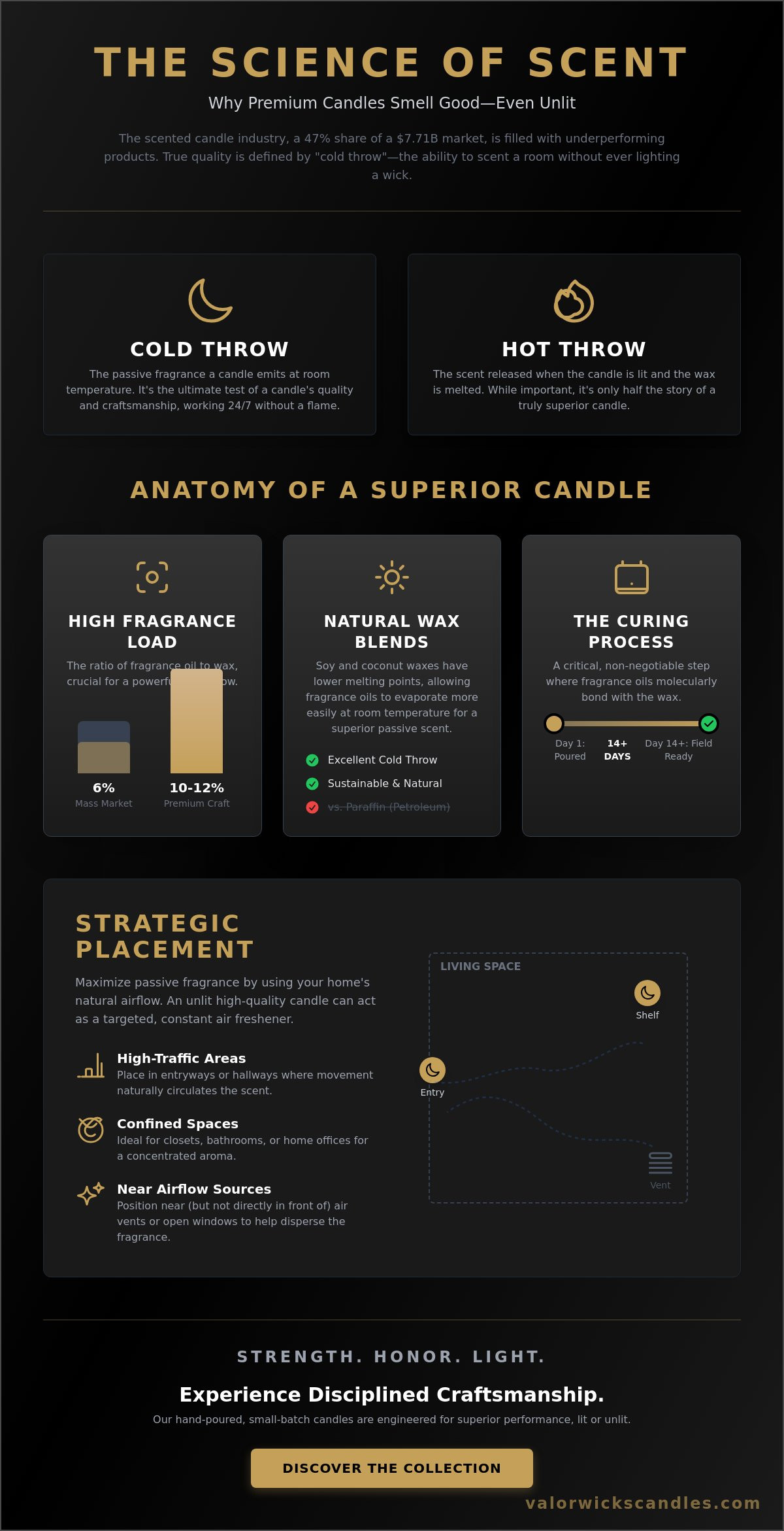
Finding this level of passive fragrance isn't magic; it's disciplined craftsmanship. With scented candles making up 47% of a global market valued at $7.71 billion in 2026, the industry is flooded with low-quality fillers. You deserve better. This guide will teach you the science of cold throw and the technical difference between wax types, including why bulk soy wax prices at $1.97 per pound matter to your nose. We're breaking down how high fragrance loads and premium wax blends create a home that smells incredible even when the wick is cold. Strength, Honor, Light.
Key Takeaways
- Master the science of cold throw to keep your space smelling premium without striking a single match.
- Identify high-performance candles that smell good even when not lit by looking for specific fragrance loads and wax densities.
- Swap synthetic paraffin for soy and coconut blends that release scent more consistently at room temperature.
- Learn tactical placement secrets that use your home's natural airflow to turn any jar into a passive air freshener.
- See why disciplined craftsmanship and high-tier oils are essential for a signature scent that lasts.
Understanding "Cold Throw": Why Some Candles Scent a Room Without a Flame
Most candle buyers focus on the flame. They're missing the mission. If your jar only works when it's on fire, you've bought a mediocre product. Cold throw is the scent a candle emits at room temperature. It’s the baseline. It’s the standard. While "hot throw" refers to the aroma released during combustion, cold throw is the quiet professional. It works while you sleep. It works while you're at work. It's the ultimate test of quality. If the wax can't hold its own in a cold state, it won't perform under pressure. Cold throw is the molecular evaporation of fragrance oils from solid wax. Finding candles that smell good even when not lit is the secret to a home that maintains its integrity 24/7.
The Importance of Passive Fragrance
Passive fragrance is about strategic discipline. You don't always want an open flame. Maybe you're too busy adulting to monitor a wick for four hours. Maybe you have a curious cat or a toddler who thinks everything is a toy. Unlit candles provide a safe, constant signature scent without the fire hazard. They offer value every hour of the day. You aren't just buying a light source. You're buying a room freshener that doesn't look like a cheap plastic plug-in. It’s about intentionality. Your space should reflect your standards. A high-quality candle serves a purpose even when you aren't "using" it. It’s functional decor. It’s a commitment to a better-smelling life.
Signs of a High-Quality Cold Throw
Quality isn't accidental. It's engineered. When you're shopping, perform the smell test. Open the lid. The scent should hit you immediately. It shouldn't require you to bury your face in the jar. A high-tier candle will fill a small radius, usually three to five feet, just by existing. Look at the wax surface. Does it look slightly greasy or exhibit "sweating"? Don't be alarmed. That’s a sign of a heavy fragrance load. Most premium brands aim for 10% or higher. This is where Soy wax properties make the difference. Natural waxes like soy and coconut have lower melting points than paraffin. This allows oils to migrate to the surface and evaporate more easily at room temperature. No fillers. No shortcuts. Just pure, disciplined craft. Strength. Honor. Light.
The Science of Scent: How Wax Type and Fragrance Load Create Unlit Aroma
Fragrance load is the tactical advantage of a premium candle. It’s the ratio of scent oil to wax. Most big-box retailers stick to a 6% load to cut costs. It’s cheap. It’s lazy. It’s the reason your living room still smells like yesterday’s takeout even with a jar sitting right there. If you want candles that smell good even when not lit, you need to demand more. High-tier, hand-poured options push that limit to 10% or even 12%. This higher concentration ensures the wax is fully saturated. When oil is distributed with military precision, it creates a constant, passive aroma. The chemistry of candles dictates that these molecules need a stable environment to evaporate effectively at room temperature. Mass-produced candles often fail because the oil settles at the bottom of the vat. Hand-pouring prevents this. It’s about integrity in the process.
Fragrance Oils vs. Essential Oils
Essential oils sound impressive on a label. They’re great for a bath, but they often lack the "legs" for a strong cold throw in a large room. They evaporate too fast. High-quality fragrance oils are engineered for stability. They feature complex layers. Top notes provide the initial punch when you walk by. Heart notes give the scent its soul. Base notes ensure the aroma stays in the air for hours. We use phthalate-free oils for a clean, non-toxic experience. No headaches. No junk. Just high-tier botanical and synthetic blends that work hard so you don't have to. It’s luxury without the pretension.
The Curing Process: The Secret to Scent Strength
Curing is where the science meets the wait. It isn't a suggestion. It’s a requirement. When wax is liquid, oil is stirred in at a specific temperature. As it cools, the molecules begin to bond. This process takes time. A freshly poured candle is a rookie. It isn’t ready for the field. Professional chandlers allow their products to cure for at least 14 days. This ensures the fragrance is fully integrated into the wax structure. If you’ve ever bought a candle that seemed weak but smelled better a month later, you’ve seen curing in action. Our Signature Collection follows this strict timeline to ensure maximum impact. We don't rush the mission. Strength. Honor. Light.
Natural vs. Synthetic: Why Soy and Coconut Blends Dominate the Cold Throw Game
Choosing the right wax is a matter of principle. It’s the difference between a high-tier atmosphere and a cheap chemical mask. Most mass-market candles rely on paraffin. It’s a petroleum byproduct. It’s also the enemy of a clean home. Paraffin is dense and non-porous. It acts like a cage for your fragrance oils. Unless you light the wick, the scent stays trapped inside the synthetic structure. This often results in a plasticky or waxy smell that ruins the vibe. If you want candles that smell good even when not lit, you need a material that breathes. You need natural wax. It’s about integrity in your ingredients.
Paraffin: The Fast-Fading Synthetic
Paraffin is the shortcut of the candle world. It’s cheap to produce but expensive for your environment. Because it’s derived from crude oil, it lacks the botanical integrity of plant-based waxes. Research into the science of cold throw shows that molecular weight and wax density dictate how fragrance escapes. Paraffin’s tight molecular structure makes passive evaporation difficult. It’s a one-trick pony. It smells okay when burning, but it’s a silent, scentless brick when unlit. We don't do shortcuts. We don't do synthetic fillers. Your home deserves a scent that works overtime.
The Soy-Coconut Advantage
Soy and coconut waxes are the gold standard. They are the elite operators of the fragrance world. Soy wax, priced at approximately $2.18 per pound in bulk as of May 2026, offers a slower and more consistent scent release. It’s porous. It allows fragrance to migrate to the surface naturally. Then there's coconut wax. It’s the heavy lifter. Pure coconut wax, costing around $6.99 per pound for smaller quantities, can hold a massive fragrance load without losing its form. Our blend combines the stability of soy with the superior throw of coconut. It’s a tactical partnership. This combination ensures your home smells like our Signature Collection even when the wick is cold. It’s clean. It’s sustainable. It’s the principled choice for your space. Strength. Honor. Light.
Strategic Placement: How to Use Unlit Candles as Passive Air Fresheners
Strategic placement is a tactical maneuver. You don't just drop a jar on a shelf and hope for the best. To maximize candles that smell good even when not lit, you need to understand airflow. Air is your transport vehicle. Place your candle near a doorway or a window where subtle drafts can carry the fragrance molecules throughout the room. It’s about leveraging the natural movement of your home. If the air is stagnant, the scent is stagnant. It’s that simple. Don't hide your candle in a deep cubby. Give it room to breathe.
Temperature is your silent partner. Even without a flame, a warm spot can boost your cold throw performance. Think of a shelf near a heating vent or a room that catches the afternoon sun. A slight increase in ambient temperature helps the fragrance oils evaporate more efficiently. Just remember the lid rule: if the lid is on, the candle is off-duty. Open it up to let the scent deploy. If you're dealing with a large hall, manage your expectations. A single jar won't scent a 500-square-foot room unlit. For those larger theaters of operation, you'll need multiple units or a more concentrated scent profile.
Best Rooms for Passive Fragrance
Small spaces are the primary theater of operations. Bathrooms and entryways are ideal because the air volume is low. In these zones, a high-quality blend acts as a permanent, reliable air freshener. For the bedroom, it’s a matter of safety and serenity. You get the calming notes of our Funny Flames Collection without the "did I blow that out?" panic at 2 AM. In the home office, a signature scent can improve focus and keep you grounded during a long day of adulting. It’s about creating an environment that matches your mission.
Maintenance Tips for Unlit Candles
Maintenance is non-negotiable. Dust is a literal barrier. It settles on the wax and traps the fragrance oils, preventing them from reaching the air. Keep your wax clean with a quick wipe. If the scent seems to fade after a few weeks, don't panic. Take a clean tool and lightly scrape the top layer of wax. This "reactivates" the surface by exposing fresh oils that haven't oxidized yet. Also, keep your jars out of direct, harsh sunlight. UV rays are the enemy of botanical integrity. They bleach the wax and break down the fragrance's chemical bonds. Treat your gear with respect. Strength. Honor. Light.
Ready to upgrade your home's passive fragrance? Explore our Signature Collection for candles engineered to perform 24/7.
Hand-Poured Integrity: The Valor & Wicks Candles Approach to Lasting Fragrance
Strength. Honor. Light. These aren't just words on a label. They're the mission profile for every jar we produce. At Valor & Wicks Candles, we don't believe in mediocre home fragrance. We believe in candles that smell good even when not lit because your standards don't take a day off. Our approach is grounded in disciplined craftsmanship and a refusal to cut corners. We use a premium soy and coconut wax blend specifically engineered for maximum cold throw. While mass producers rely on cheap paraffin and low oil loads, we lean into quality. Every candle is hand-poured in small batches at our dedicated facility. This ensures the fragrance oils are evenly distributed from the first millimeter of wax to the very bottom. No dead zones. No wasted wax. Just pure performance.
Hand-pouring isn't just a marketing term; it's a quality control measure. In large-scale factories, fragrance oils can separate or settle, leading to inconsistent scent. Our small-batch process allows us to monitor the exact temperature during the oil-to-wax bonding phase. This precision ensures that the molecular evaporation we discussed earlier happens consistently across the entire surface. We take our production process seriously so you can enjoy a home that smells incredible without effort. It’s about intentionality. It’s about the mission to transform your space. We don't just sell wax; we sell an atmosphere that stays on duty 24/7.
The Valor & Wicks Candles Quality Standard
Precision matters in every component. We use phthalate-free, high-tier fragrance oils to ensure a clean experience that won't cause the headaches associated with synthetic junk. Our lead-free cotton wicks are selected for both safety and performance. As a veteran-owned business, we inspect every unit for scent integrity before it leaves our shop. If it doesn't meet the standard, it doesn't ship. This veteran-led discipline means you get a product built with integrity. We value the power of light and scent to change a mood, whether you're relaxing after a long shift or just trying to survive a day of adulting. No fluff. No pretension. Just high-tier goods.
Finding Your Passive Scent
Choosing a scent is a personal tactical decision. Our Signature Collection offers sophisticated, room-filling aromas that command attention even when the wick is cold. If you prefer something more indulgent, our Dessert Collection smells good enough to eat without ever striking a match. Imagine the scent of fresh pastries wafting through your kitchen as a permanent background note. It’s the ultimate life hack for a busy home. From our "Funny Flames" to our most elegant botanical blends, every candle is designed to be noticed. Shop our Signature Collection for candles that transform your space.
Take Command of Your Home’s Atmosphere
You've seen the science. You've got the strategy. Now it's time to execute. Passive fragrance is about refusing to compromise on your environment just because you aren't striking a match. By investing in candles that smell good even when not lit, you maintain a superior scent profile regardless of the time or the fire hazard. Whether you're strategically placing jars in your entryway or choosing natural waxes that breathe, you're taking control of your space. It's about creating a home that reflects your standards every hour of the day.
Valor & Wicks Candles exists to meet those standards. We are veteran-owned and operated, bringing mission-focused discipline to every hand-poured batch. Our soy and coconut wax blends are built for performance, using only phthalate-free and lead-free materials. We don't do synthetic fillers. We don't do weak throws. Experience premium scents with our Signature Collection to see the difference that craftsmanship makes. Your home deserves an atmosphere that stays on duty 24/7. Strength. Honor. Light.
Frequently Asked Questions
Do candles lose their scent if you don’t light them?
Yes, candles can lose their scent over time through oxidation. Fragrance oils are volatile compounds. They evaporate slowly at room temperature. If you leave a jar open for 12 months, the top layer will weaken. Keep the lid on when you aren't using it for passive fragrance. This preserves the botanical integrity of the oils for up to two years. Strength. Honor. Light.
Which candle wax has the strongest cold throw?
Coconut wax is the gold standard for cold throw. It has a lower melting point and a more porous molecular structure than paraffin. This allows candles that smell good even when not lit to release aroma more efficiently. When blended with soy, it provides the stability needed to hold a high fragrance load. This combination ensures your room smells like a signature collection, not a plastic factory.
How long does a candle smell good without being lit?
A high-quality candle provides passive fragrance for several months. The initial punch is strongest in the first 90 days. After that, the top layer of wax may oxidize. You can extend this lifespan by keeping the candle in a cool, dark place. If the scent dips, a quick maintenance scrape of the top wax layer often restores the aroma. It's about maintaining your gear.
Can I use a candle warmer instead of lighting the wick?
You can absolutely use a candle warmer to boost the scent. It's a tactical choice for those who want zero fire risk. The warmer heats the wax just enough to liquefy it without combustion. This releases the fragrance oils faster than a cold throw but slower than a flame. It's perfect for home offices where you're too busy adulting to watch a wick.
Is it safe to leave a candle lid off all the time?
It's safe, but it's not efficient. Leaving the lid off allows dust to collect on the wax surface. Dust acts as a physical barrier that traps fragrance molecules. It also speeds up the evaporation of the top-level scent notes. For the best results, deploy the scent by removing the lid for a few hours, then seal it back up to preserve the integrity of the remaining oils.
Why does my candle smell like nothing when I first open it?
This usually happens due to poor curing or olfactory fatigue. If a candle hasn't cured for at least 14 days, the oil and wax haven't fully bonded. Another factor is your own nose. If you've been around strong scents all day, your brain might tune out the new aroma. Step outside for five minutes, then come back. If it still smells like nothing, the fragrance load is likely too low.
How can I make my candle smell stronger without burning it?
Increase the surface area or the ambient temperature. You can lightly scrape the top layer of the wax to reveal fresh, unoxidized oils. This is a quick win for candles that smell good even when not lit. Placing the jar in a warm spot, like near a sunny window or a desk lamp, also helps. Just avoid direct UV rays that can degrade the botanical oils over time.
Does the size of the candle affect the cold throw?
Yes, the surface area of the wax directly impacts the scent throw. A wider jar has more real estate for fragrance molecules to evaporate from. A 12-ounce jar will always outperform a 4-ounce travel tin in a large room. If you want a passive scent to fill a living room, go for a larger diameter. For small bathrooms, a smaller jar is the correct tool.