

Best Candles for People with Allergies: The 2026 Clean Burn Guide
What if the "signature scent" you love isn't the problem, but the hidden toxins inside the jar are actually attacking your sinuses? Finding the best candles for people with allergies shouldn't feel like a tactical mission. For many, lighting a candle is a gamble that ends in a sinus headache or a heavy chest. You want the ambiance. You want the "adulting" win of a clean-smelling home. It's frustrating when your environment betrays your respiratory system.
We promise to show you how to enjoy premium fragrances without the sneezing. This guide breaks down the May 1, 2026, EU CLP labeling mandates and the EPA's recent crackdown on five major phthalates, including BBP and DBP. We will explore why 100% natural wax is the elite choice for sensitive lungs and how to spot wicks that meet the 0.06% lead content limit. Get ready to reclaim your space with strength, honor, and clean light.
Key Takeaways
- Identify the hidden sinus triggers in paraffin and metal-core wicks. Stop the "candle headache" before it starts.
- Discover why soy and coconut blends are the best candles for people with allergies. Clean wax. Low soot. Zero compromise.
- Navigate 2026 EPA regulations on phthalates. Ensure your home stays free from toxic VOCs and respiratory irritants.
- Master a simple checklist for verifying lead-free cotton wicks. Demand transparency in every jar you burn.
- See how veteran-led craftsmanship delivers premium scents without the respiratory fallout. Strength, honor, and clean light.
Why Traditional Candles Trigger Allergies and Headaches
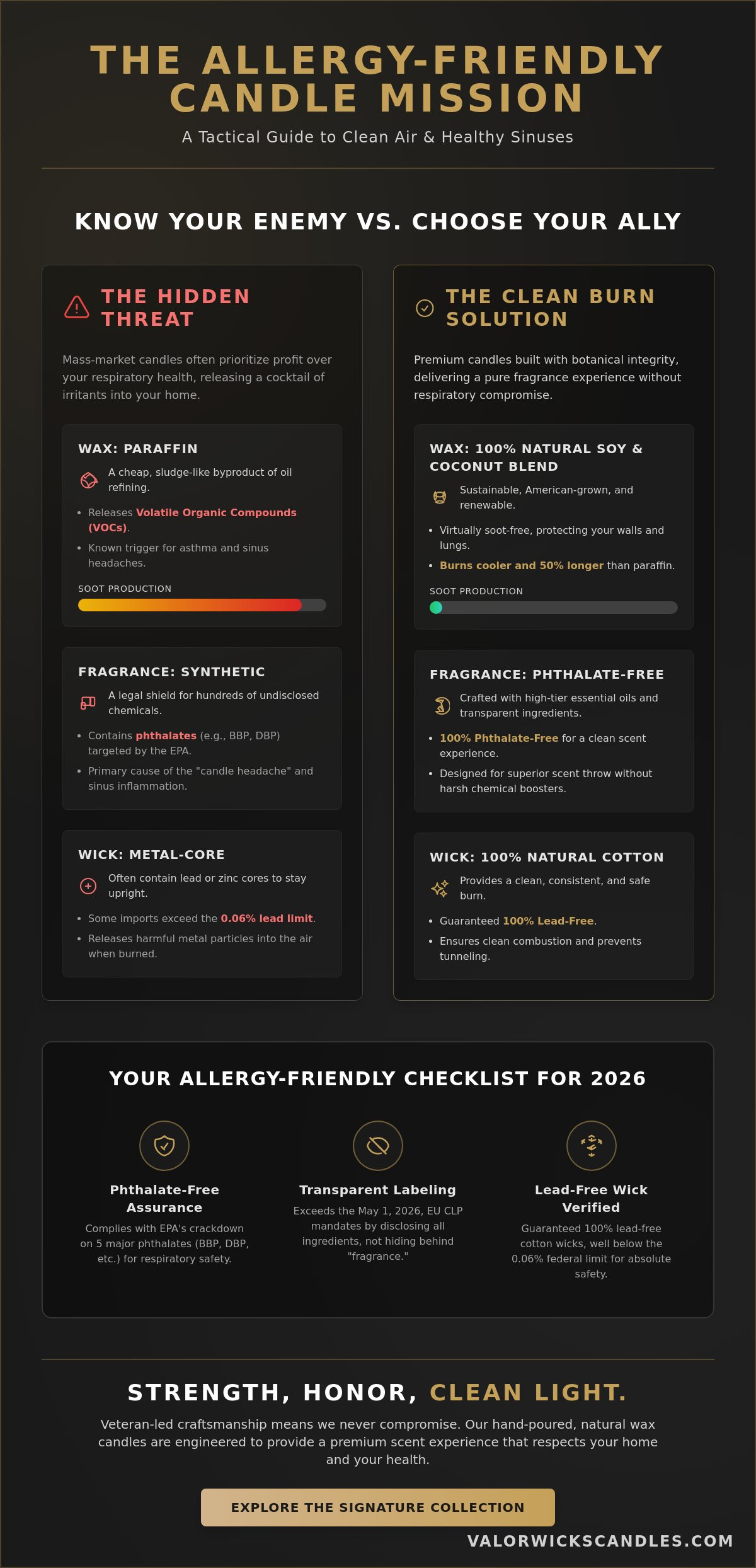
You have probably felt it. You light a mass-market candle, and ten minutes later, your head is thumping. Your nose feels stuffed. Your eyes might even start to itch. This isn't just a "sensitivity" to smells. It's a physiological response to chemical triggers released into your personal airspace. Finding the best candles for people with allergies starts with identifying the culprits hiding in plain sight. Traditional candles often rely on a cocktail of three major irritants: paraffin wax, synthetic dyes, and metal-core wicks. These ingredients prioritize profit over respiratory health.
Cheap synthetic fragrances are the primary cause of the infamous "candle headache." These scents are often engineered with chemical boosters to ensure the smell is unnaturally strong. They don't just fill a room; they attack the nervous system. For a sensitive individual, there is a massive difference between a natural scent and a chemical trigger. Soot is the carbon byproduct of incomplete combustion.
The Paraffin Problem: Petroleum in Your Living Room
Paraffin is not a clean or natural substance. It's a sludge-like byproduct of the oil refining process. When you burn a paraffin candle, you are essentially running a small internal combustion engine inside your home. With crude oil priced at $95.74 USD/Bbl as of May 8, 2026, paraffin remains a cheap filler for big-box retailers, but the biological cost is high. Burning this petroleum waste releases Volatile Organic Compounds (VOCs) directly into your breathing zone. People living with asthma or COPD are particularly vulnerable to these airborne pollutants. It's an unnecessary tactical error for your health.
Synthetic Fragrances vs. Your Sinuses
The "fragrance" label on a standard jar is often a legal shield for hundreds of undisclosed chemicals. Many of these hidden ingredients are known respiratory irritants that cause immediate sinus inflammation. Mass-market brands use these synthetic blends because they're cheap and potent. However, they lack the botanical integrity required for a clean burn.
- Paraffin Wax: Petroleum-based base that produces heavy soot.
- Synthetic Dyes: Chemical additives that can off-gas when heated.
- Metal-Core Wicks: Some imports still struggle to stay below the 0.06% lead weight limit.
The Best Waxes for Allergy Sufferers: Soy and Coconut
If paraffin is the tactical failure of the candle world, plant-based waxes are the elite reinforcements. You don't have to settle for air quality that mimics a highway tunnel. The best candles for people with allergies rely on the botanical integrity of soy and coconut. These waxes aren't just "alternative" options. They're the gold standard for anyone who values their lung capacity as much as their home's aesthetic. We approach raw materials with a mindset of strength, honor, and light. That means no shortcuts. No petroleum fillers. Just high-tier craftsmanship.
Choosing renewable waxes isn't just a trend. It's a health-first strategy. While paraffin wax prices hit $1.22 USD/KG in North America as of April 2026, the real cost of cheap wax is measured in respiratory flare-ups. Plant-based waxes burn cooler. They burn longer. Most importantly, they burn without releasing the toxic baggage of their petroleum-based cousins. This is how you reclaim your space from the "adulting" struggle of sinus congestion.
Soy Wax: The Renewable Powerhouse
Soy wax is the backbone of the clean-burn movement. It's derived from American-grown soybeans, making it a sustainable choice that supports local agriculture. Because soy wax has a lower melting point than paraffin, your candle lasts significantly longer. It's naturally biodegradable. If you spill it, you clean it with soap and water. No industrial solvents required. It offers a reliable, steady burn that keeps your air clear and your mind focused. It's disciplined light for a principled home.
Coconut Wax: The Secret to a Soot-Free Home
Coconut wax is the high-performance upgrade. It's virtually soot-free. This is critical for maintaining white walls and healthy sinuses. While some competitors list soy and rapeseed as options, they often miss why a blend is superior. We use a soy-coconut blend to capture the best of both worlds. You get the structural integrity of soy combined with the creamy, low-soot finish of coconut. This blend provides a superior scent throw without needing the harsh chemical "boosters" found in mass-market jars. If you're ready to upgrade your atmosphere, explore our Signature Collection for a burn that respects your air.
This hybrid approach ensures the candle performs under pressure. It doesn't tunnel. It doesn't smoke. It just delivers a premium experience that won't leave you reaching for the antihistamines. When you choose the best candles for people with allergies, you're investing in a product that takes its production process as seriously as a mission briefing. Pure wax. Clean burn. Strength and honor in every jar.
Fragrance Without the Fallout: Phthalate-Free Integrity
Most guides tell you to stick to unscented candles if you have a sensitive nose. That is a total surrender. You shouldn't have to live in a sterile, scent-free void just because your sinuses are on high alert. The best candles for people with allergies aren't necessarily odorless. They are simply engineered without the chemical garbage found in mass-market brands. Phthalate-free oils are the standard for modern candle safety. By choosing high-tier artisanal oils, you can enjoy a complex signature scent without the toxic load that usually triggers a respiratory flare-up.
The myth that all fragrance oils are bad for allergies is a tactical error. The real enemy is the hidden chemical fillers used to cut costs and boost performance artificially. We believe in transparency and duty. This means selecting oils that provide a powerful scent throw while maintaining biological integrity. It is about craftsmanship, not just chemistry. You want a home that smells like an actual sanctuary, not a laboratory experiment gone wrong.
What Are Phthalates and Why Are They in Candles?
Phthalates are plasticizers. Big-box brands use them because they make scents last longer and cost less to produce. However, the U.S. Environmental Protection Agency (EPA) has announced its intention to regulate five specific phthalate chemicals: BBP, DBP, DCHP, DEHP, and DIBP. These compounds are linked to endocrine disruption and significant respiratory distress. Burning a candle that contains these is like inviting a chemical irritant to a dinner party. Valor & Wicks refuses to use any oil containing these compounds. We prioritize your health over a cheaper production line. Strength and honor demand nothing less.
Safe Scents: From Desserts to Signature Blends
You can have your cake and smell it too. Our Dessert Collection proves that "Cereal Bowl" or "Coffee Shop" scents don't have to be triggers. We achieve these nostalgic aromas through rigorous testing. We ensure the "throw" of the scent fills the room without becoming an airborne irritant. It is a delicate balance that requires disciplined production.
- Botanical Integrity: We favor fragrance profiles that soothe the senses naturally.
- Rigorous Testing: Every blend is burned to ensure it doesn't cause that "heavy" chest feeling.
- No Synthetic Boosters: We don't use harsh chemicals to fake a stronger smell.
The Allergy-Friendly Candle Checklist for 2026
Knowledge is your best defense. Don't get sidelined by marketing fluff. Finding the best candles for people with allergies requires a tactical approach to label reading. You need a checklist that cuts through the noise. Most big-box brands hide behind vague terms like "wax blend" or "natural fragrance." These are often red flags for petroleum fillers and hidden irritants. Follow these four steps to secure your home's air quality and enjoy your space without the sinus fallout.
- Step 1: Verify the wax type. Avoid "Paraffin" or "Wax Blend" without specific percentages. If it doesn't say 100% plant-based, it likely contains petroleum.
- Step 2: Check the wick material. Demand 100% lead-free cotton or sustainably sourced wood. Your lungs will thank you.
- Step 3: Confirm phthalate-free status. Ensure the fragrance oils meet the 2026 safety standards set by the EPA.
- Step 4: Seek small-batch integrity. Look for handcrafted labels. Small-batch production ensures a level of quality control that mass-market factories simply can't match.
The Wick Matters: Lead-Free and Mission-Ready
The wick is the engine of the candle. If the engine is dirty, the exhaust is toxic. While the U.S. Consumer Product Safety Commission (CPSC) bans lead-cored wicks under 16 CFR § 1500.17(a)(13), some cheap imports still skirt the 0.06% lead weight limit. We use 100% cotton wicks for a steady, low-smoke flame. Here is a tactical tip: keep your wick trimmed to 1/4 inch. Proper maintenance reduces smoke and prevents soot from migrating to your walls or your lungs. It's a simple discipline for a cleaner burn.
Transparent Labeling: Reading Between the Lines
Beware of the "Natural" trap. In the candle industry, a product can be labeled "Natural" even if it contains 49% paraffin wax. It's a marketing loophole that exploits your trust. As of January 1, 2026, states like Washington have tightened regulations on chemical classes, but you still need to be vigilant. Products that are "Hand-Poured in the USA" often correlate with higher safety standards and better raw materials. We don't hide behind vague terminology. Our process is built on transparency and intentionality. If you want a burn you can actually trust, explore our Signature Collection for high-tier craftsmanship. Adulting is hard enough. Your candle shouldn't make it harder. Strength, honor, light.
Valor & Wicks: Hand-Poured Integrity for Your Home
We don't do "good enough." We do it right. Our veteran-owned roots mean every jar we pour is treated like a mission briefing. There is no room for error when your respiratory health is on the line. Creating the best candles for people with allergies requires a level of discipline that mass-market factories can't replicate. It's about high-tier craftsmanship. It's about the promise of a clean burn. We believe your home should be a sanctuary, not a source of sinus stress. Strength, honor, and light aren't just words. They are the standard for every soy and coconut blend we produce.
Integrity is our moral and aesthetic anchor. When you choose a candle from our Signature Collection, you are getting a product that has been vetted for purity. We refuse to compromise on raw materials. This means zero paraffin. Zero phthalates. Zero lead. We understand the "adulting" struggle of wanting a beautiful home without the headache factor. By combining veteran-led discipline with a modern, irreverent wit, we've created a brand that is both premium and relatable. We take our process seriously so you can take your relaxation seriously.
Small Batch Discipline
Every Valor & Wicks candle is hand-poured in Binghamton, New York. We maintain rigorous quality checks on every single batch. Small-batch production is the tactical choice for people with chemical sensitivities. It allows us to ensure that zero cross-contamination occurs. We don't use petroleum fillers. We don't use metal-core wicks. By keeping our production local and intentional, we maintain a purity that big-box retailers lose in their supply chains. When you support our veteran-owned business, you're choosing a brand that values your family’s health as much as you do. It's about integrity in every pour. It's about knowing exactly what is burning in your living room.
Ready to Light Up Your Space?
It is time to stop settling for candles that make you sneeze. You deserve a premium scent profile without the respiratory fallout. Whether you need the nostalgic comfort of our Dessert Collection or a laugh from our Funny Flames Collection, we have you covered. Our "I Don’t Want to Adult Today" themed candle is the perfect safe gift for anyone who needs a break from the grind. We also offer Wax Melts for those who prefer flameless fragrance. We provide national shipping across the United States, bringing clean-burning light directly to your door. Explore our full catalog today and discover how high-quality botanical ingredients transform your environment. Reclaim your home. Choose light that respects your lungs. Strength, Honor, Light.
Secure Your Airspace and Reclaim Your Home
Reclaiming your home from sinus congestion is a tactical necessity. You've learned that petroleum-based waxes and hidden phthalates are the primary triggers for respiratory flare-ups. By switching to 100% natural soy and coconut wax, you eliminate the toxic soot that traditional jars release. It's a win for your lungs and your white walls. You don't have to sacrifice a fragrant home to maintain your health. Clean air is a mission requirement.
Finding the best candles for people with allergies comes down to integrity. Our veteran-owned and operated shop focuses on high-tier craftsmanship. Every jar is hand-poured in the USA with lead-free cotton wicks. No shortcuts. No chemical boosters. Just clean light for a disciplined home. Adulting is hard enough without a sinus headache. We take the production process seriously so you can finally relax. It's time to stop the sneezing and start enjoying your space again.
Shop our Phthalate-Free Signature Collection and experience the difference of a truly clean burn. You deserve a space that smells like a sanctuary. It's time to burn with honor. Strength, Honor, Light.
Frequently Asked Questions
Can people with asthma use scented candles?
Yes, people with asthma can enjoy scented candles if they avoid petroleum-based paraffin. The key is finding a clean burn that doesn't trigger a bronchial response. Focus on 100% natural waxes and phthalate-free oils. These are the best candles for people with allergies because they prioritize air quality over cheap production costs. Always ensure the room has proper ventilation to keep the mission on track.
What is the absolute healthiest candle wax to burn?
A blend of 100% soy and coconut wax is the healthiest choice for your home. This botanical mix burns at a lower temperature and produces nearly zero soot. Unlike paraffin, which is a byproduct of oil refining, these plant-based waxes don't release toxic pollutants into your breathing zone. It is high-tier craftsmanship for a principled environment.
Why do some candles give me an immediate headache?
Immediate headaches are typically caused by synthetic fragrance "boosters" and Volatile Organic Compounds (VOCs). When these chemicals burn, they can irritate the nervous system. The EPA's 2026 focus on regulating five major phthalates proves these ingredients are a health risk. If a candle makes your head throb, it is a tactical failure in the jar's chemistry.
Are soy candles actually better for allergies than paraffin?
Soy candles are significantly better because they are made from renewable soybeans rather than crude oil. Paraffin releases heavy carbon soot that can irritate the sinuses and lungs. While the Paraffin Wax Price Index rose 1.12% in early 2026, the real cost is the respiratory distress it causes. Soy provides a cleaner, longer-lasting burn for a healthier home.
What does "phthalate-free" mean in candle making?
Phthalate-free means the fragrance oils are formulated without plasticizers like BBP, DBP, or DEHP. These chemicals are traditionally used to make scents last longer, but they are known endocrine disruptors. Valor & Wicks refuses to use them. We believe in providing a premium signature scent without the toxic baggage. It's about duty to the customer.
How can I tell if a candle has a lead wick?
You can identify a lead wick by looking for a metal wire core inside the cotton strands. If you rub the tip of an unburnt wick on a piece of white paper and it leaves a gray mark, it's likely lead. While the CPSC ban under 16 CFR § 1500.17(a)(13) is strict, some cheap imports still bypass these safety standards. Stick to trusted, hand-poured brands.
Do beeswax candles really purify the air?
Beeswax is a clean-burning wax, but the idea that it purifies air through negative ions is largely anecdotal. It doesn't function like a mechanical air filter. It is, however, a fantastic natural option for anyone seeking the best candles for people with allergies. It offers a subtle, natural honey scent without synthetic additives.
Can I be allergic to the essential oils in a candle?
Yes, it's entirely possible to have a reaction to essential oils. Natural does not always mean hypoallergenic. Some botanical oils, like cinnamon or certain floral extracts, can be potent triggers for sensitive respiratory systems. Always test a new scent in a large room first. If you feel a flare-up, abort the burn immediately.